
Who Was King Tutankhamun? 10 Amazing Facts About the Boy King
Who Was King Tutankhamun? 10 Fascinating Facts About Egypt’s Boy King
Who Was King Tutankhamun? This question leads to one of the most fascinating stories in Ancient Egyptian history. Although Tutankhamun ruled Egypt for only a short time, his name became famous around the world after the discovery of his remarkably preserved tomb in the Valley of the Kings.
Tutankhamun became pharaoh when he was still a child, ruling during a period of major religious and political change. His reign was relatively brief, and many details about his life remain uncertain. Yet the treasures discovered inside his tomb transformed him into one of the most recognizable pharaohs in history.
Today, travelers visiting Luxor can explore the Valley of the Kings and learn more about the young ruler whose burial treasures captured global attention. Understanding Who Was King Tutankhamun also provides an opportunity to discover how religion, royal power, family politics, and burial traditions shaped Ancient Egypt.
This guide explores Tutankhamun’s life, family, reign, tomb, treasures, death, and enduring legacy.
Who Was King Tutankhamun?
Tutankhamun was an Egyptian pharaoh of the 18th Dynasty, during the New Kingdom period. He became king while still very young and ruled Egypt for approximately a decade before his death.
His original name was Tutankhaten, meaning “Living Image of Aten.” After the restoration of the traditional Egyptian religious system, his name changed to Tutankhamun, meaning “Living Image of Amun.”
His reign took place after the dramatic religious reforms of his predecessor, Akhenaten.
Although Tutankhamun was not one of Egypt’s most powerful military rulers, his historical importance comes from the period in which he lived and the extraordinary preservation of his royal burial.
1. Tutankhamun Became Pharaoh as a Child
One of the most remarkable facts about Who Was King Tutankhamun is that he became ruler while still a child.
Most estimates place his accession to the throne at around the age of nine.
Because he was so young, powerful officials and advisers likely played an important role in governing the kingdom.
Among the important figures associated with the young king were Ay and Horemheb, who later became pharaohs themselves.
Tutankhamun’s youth meant that his reign was shaped by adults who helped manage political, religious, and administrative affairs.
2. Tutankhamun Restored Egypt’s Traditional Religion
To understand Who Was King Tutankhamun, it is essential to understand the religious revolution that happened before his reign.
His predecessor Akhenaten promoted the worship of the Aten, the sun disk, and reduced the traditional role of many other Egyptian gods.
Akhenaten also established a new royal capital at Amarna.
After his death, Egypt gradually returned to its traditional religious system.
Tutankhamun played an important role in this restoration.
His name was changed from Tutankhaten to Tutankhamun, emphasizing the return of the god Amun.
Temples and traditional religious institutions were restored, and the royal court moved away from the religious policies associated with Akhenaten.
3. Tutankhamun Was Connected to Akhenaten
Tutankhamun’s family history is complex.
Modern archaeological and genetic research has provided important information about his family, although some relationships remain debated.
Tutankhamun was closely connected to Akhenaten and the royal family of the Amarna period.
His mother is generally identified through genetic evidence as an unnamed royal woman known as the “Younger Lady.”
Tutankhamun’s exact paternal ancestry has also been studied extensively, with evidence linking him closely to Akhenaten.
His family connections demonstrate how closely related members of the royal household could be during the 18th Dynasty.
4. He Married Ankhesenamun
Tutankhamun married Ankhesenamun, a member of the royal family.
She was closely connected with the Amarna royal household and was likely a daughter of Akhenaten and Nefertiti or closely related to them, although aspects of her parentage remain uncertain.
The marriage was important because royal families often used marriage to maintain dynastic continuity.
Two fetal remains discovered in Tutankhamun’s tomb are believed to have been daughters of the king and Ankhesenamun.
These discoveries provide a tragic glimpse into the personal life of the young royal couple.
5. His Reign Was Relatively Short
Tutankhamun ruled Egypt for approximately ten years.
Compared with famous rulers such as Ramses II, his reign was extremely short.
He did not have enough time to establish a vast empire or commission the enormous number of monuments associated with some other New Kingdom pharaohs.
Nevertheless, his reign was significant because it helped stabilize Egypt after the religious upheaval of the Amarna period.
Restoring traditional religious practices was one of the most important developments of his rule.
6. Tutankhamun’s Tomb Was Discovered in the Valley of the Kings
The discovery of Tutankhamun’s tomb transformed his place in modern history.
The tomb, designated KV62, was discovered in the Valley of the Kings in 1922 by British archaeologist Howard Carter.
It was one of the most important archaeological discoveries ever made.
The tomb had been disturbed in antiquity, but much of its burial equipment remained.
Inside, Carter and his team found thousands of objects associated with the king’s burial.
These included furniture, weapons, jewelry, statues, chariots, clothing, ceremonial objects, and other treasures.
7. The Golden Mask Became a Symbol of Ancient Egypt
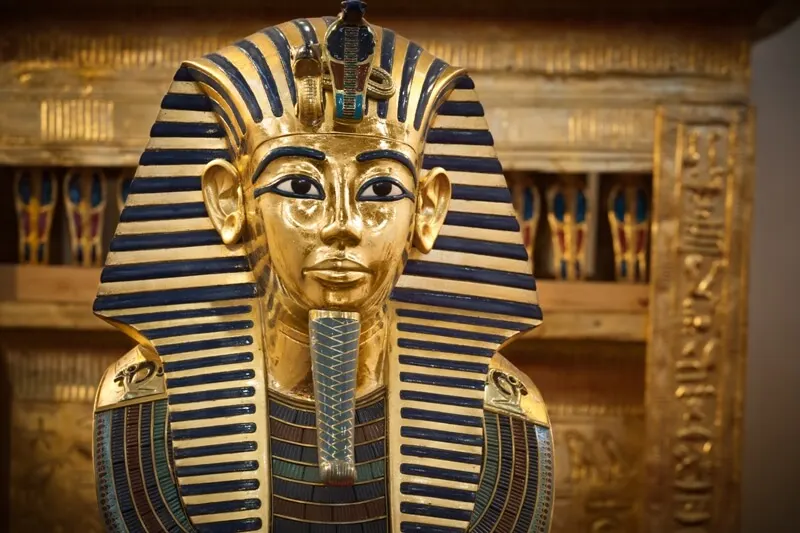
Perhaps the most famous object associated with Tutankhamun is his golden funerary mask.
The mask is made primarily of gold and decorated with precious and semi-precious materials.
It depicts the young king wearing the traditional nemes headdress associated with Egyptian royalty.
The mask has become one of the world’s most recognizable archaeological artifacts.
Its extraordinary craftsmanship demonstrates the skills of Egyptian goldsmiths and artisans during the New Kingdom.
The mask also helped transform Tutankhamun into a global cultural icon.
8. Tutankhamun’s Tomb Was Packed With Treasures
The tomb contained an extraordinary collection of objects.
Among the discoveries were:
- Golden funerary equipment
- Royal furniture
- Chariots
- Weapons
- Jewelry
- Statues
- Clothing
- Walking sticks
- Ceremonial objects
- Food and other burial provisions
These objects provide valuable information about royal life, craftsmanship, religious beliefs, and burial traditions during the 18th Dynasty.
Unlike many ancient royal tombs that were robbed extensively in antiquity, Tutankhamun’s burial preserved an unusually large collection of objects.
This is one of the main reasons Who Was King Tutankhamun remains such a popular historical question.
9. How Did King Tutankhamun Die?
The exact cause of Tutankhamun’s death has been debated for decades.
He died at approximately 18 or 19 years old.
Scientific investigations have identified several health conditions and injuries, but there is no single explanation that answers every question about his death.
Research has suggested that malaria, genetic factors, and a leg injury may have contributed to his poor health.
Some earlier theories proposed murder, but there is no conclusive evidence establishing that Tutankhamun was assassinated.
The most likely explanation involves a combination of health problems rather than a simple dramatic murder story.
10. Tutankhamun’s Burial Changed Archaeology Forever
The discovery of Tutankhamun’s tomb had an enormous impact on archaeology and popular culture.
Few archaeological discoveries had ever attracted such worldwide attention.
Newspapers reported the discovery, museums displayed artifacts, and public fascination with Ancient Egypt grew dramatically.
The discovery also helped researchers study New Kingdom royal burial practices in extraordinary detail.
Tutankhamun’s treasures continue to provide information about Egyptian craftsmanship, religion, art, and royal culture.
Where Is Tutankhamun’s Tomb?
Tutankhamun’s tomb is located in the Valley of the Kings on the West Bank of Luxor.
The Valley served as a royal cemetery during much of the New Kingdom.
Instead of building massive pyramids, New Kingdom pharaohs were generally buried in hidden rock-cut tombs.
The location helped protect royal burials from some of the threats faced by earlier monumental tombs.
Today, visitors can explore parts of the Valley of the Kings and, depending on current access arrangements, visit Tutankhamun’s tomb.
The valley is one of the most important historical attractions in Egypt.
What Can Visitors See Inside Tutankhamun’s Tomb?
The tomb is relatively small compared with some of the larger royal tombs in the Valley of the Kings.
Its walls contain important painted scenes and inscriptions associated with the king’s journey into the afterlife.
Visitors can observe the burial chamber and decorations while learning about the discovery of the tomb.
The experience is particularly meaningful when combined with a visit to other New Kingdom tombs and temples in Luxor.
Tutankhamun and the Valley of the Kings
The story of Who Was King Tutankhamun cannot be separated from the Valley of the Kings.
The valley contains dozens of royal and non-royal tombs, including the burial places of important New Kingdom rulers.
Tutankhamun’s tomb is famous because of its exceptional archaeological discovery, but the surrounding valley contains many other spectacular tombs.
Visitors interested in Egyptian history should consider exploring several tombs rather than focusing only on Tutankhamun.
Why Was Tutankhamun’s Tomb So Well Preserved?
Tutankhamun’s tomb was not completely untouched when Howard Carter discovered it.
Evidence indicates that it was entered and disturbed in antiquity.
However, the burial remained far more intact than many other royal tombs.
Its relatively modest size and location may have helped protect it from later attention.
The tomb may also have been partially covered by debris associated with later construction.
As a result, many burial objects survived until the modern discovery.
Tutankhamun’s Treasures and Ancient Egyptian Culture
The objects found in the tomb provide a remarkable picture of royal life.
Furniture shows the sophistication of Egyptian woodworking.
Jewelry demonstrates advanced metalworking and stone craftsmanship.
Weapons reveal aspects of royal military culture.
Chariots demonstrate the importance of horses and elite transportation.
Funerary equipment reveals Egyptian beliefs about death and the afterlife.
Together, these discoveries make Tutankhamun’s tomb an extraordinary historical archive.
Did Tutankhamun Build the Pyramids?
No.
Tutankhamun lived more than a thousand years after the construction of the Great Pyramid of Giza.
The Great Pyramid was built for Pharaoh Khufu during the Fourth Dynasty, while Tutankhamun belonged to the 18th Dynasty.
This difference highlights the enormous length of Egyptian history.
When Tutankhamun became pharaoh, the Great Pyramid was already an ancient monument.
The young king lived closer in time to the construction of later New Kingdom temples than to the builders of Giza.
Why Is Tutankhamun So Famous Today?
Tutankhamun was not the longest-reigning, most powerful, or most successful military pharaoh in Egyptian history.
His fame largely comes from the exceptional discovery of his tomb.
The wealth of objects preserved inside KV62 created an unprecedented opportunity to study Egyptian royal burial practices.
His golden mask became a global symbol of Ancient Egypt.
The combination of his young age, mysterious death, spectacular treasures, and archaeological discovery created an enduring fascination.
Frequently Asked Questions
Who Was King Tutankhamun?
Tutankhamun was an 18th-Dynasty Egyptian pharaoh who became king as a child and ruled for approximately a decade. He is best known today for his remarkably preserved tomb in the Valley of the Kings.
How old was Tutankhamun when he became pharaoh?
Tutankhamun is generally believed to have become king at around nine years old.
How old was Tutankhamun when he died?
He was approximately 18 or 19 years old when he died.
Who discovered Tutankhamun’s tomb?
British archaeologist Howard Carter discovered the tomb in the Valley of the Kings in 1922.
Where is King Tutankhamun’s tomb?
Tutankhamun’s tomb, known as KV62, is located in the Valley of the Kings on Luxor’s West Bank.
Who was Tutankhamun’s wife?
Tutankhamun married Ankhesenamun, a member of the Amarna royal family.
What is Tutankhamun famous for?
He is famous primarily because his tomb contained an extraordinary collection of royal burial objects, including his famous golden funerary mask.
How did King Tutankhamun die?
The exact cause remains uncertain. Scientific studies have identified several health problems that may have contributed to his death at a young age.
Was Tutankhamun related to Akhenaten?
Genetic and archaeological evidence indicates a close family relationship between Tutankhamun and Akhenaten, although some details of the royal family tree remain debated.
Conclusion
So, Who Was King Tutankhamun? He was a young pharaoh of Egypt’s 18th Dynasty who inherited a kingdom recovering from major religious and political changes.
His reign was short, but he helped restore traditional Egyptian religious practices after the Amarna period. His family connections, marriage to Ankhesenamun, early death, and remarkable burial created one of the most fascinating stories in Egyptian history.
The discovery of his tomb in 1922 transformed his reputation. The golden mask and thousands of burial objects provided an extraordinary glimpse into the wealth, craftsmanship, beliefs, and traditions of New Kingdom Egypt.
Today, Tutankhamun’s story remains an essential part of any exploration of Ancient Egypt. Visiting the Valley of the Kings and learning about his tomb allows travelers to connect with a young ruler whose brief life left an astonishing legacy that continues to fascinate the world.