
Pyramid Myths vs Historical Facts: 10 Amazing Truths Revealed
Pyramid Myths vs Historical Facts – 10 Fascinating Truths About Egypt’s Pyramids
Pyramid Myths vs Historical Facts is a fascinating subject for anyone interested in Ancient Egypt. For thousands of years, the pyramids have inspired stories about mysterious builders, hidden treasures, supernatural powers, lost civilizations, and unexplained technologies.
The pyramids certainly remain extraordinary. However, many popular claims about them are very different from what archaeological evidence tells us.
The Great Pyramid of Giza, the Pyramid of Khafre, the Pyramid of Menkaure, and the other pyramids across Egypt were created by an ancient civilization with remarkable knowledge of architecture, mathematics, astronomy, quarrying, transportation, and administration.
Understanding Pyramid Myths vs Historical Facts does not make these monuments less mysterious. Instead, the archaeological evidence makes their achievements even more impressive.
In this guide, we examine some of the most popular pyramid myths and compare them with historical and archaeological evidence.
Why Pyramid Myths Became So Popular
The pyramids are among the oldest surviving monumental structures on Earth. Their enormous size and extraordinary precision naturally encourage questions.
How did ancient workers move such massive stones? How were they aligned so accurately? Why do some theories connect them with astronomy or mysterious energy?
Over centuries, unanswered questions have created countless stories.
Some theories are based on genuine historical questions, while others have little archaeological support.
The goal of Pyramid Myths vs Historical Facts is not to eliminate the mystery surrounding Egypt’s pyramids. Instead, it is to distinguish between evidence-based history and speculation.
Pyramid Myths vs Historical Facts: 10 Amazing Truths
1. Myth: Aliens Built the Egyptian Pyramids
One of the most famous modern pyramid myths claims that extraterrestrial beings constructed the pyramids because ancient Egyptians supposedly lacked the technology required to build them.
Historical Fact
Archaeological evidence provides a completely different explanation.
Researchers have discovered evidence of workers’ settlements, tools, quarries, food production, transportation systems, and administrative organization associated with pyramid construction.
Ancient Egyptian builders possessed practical knowledge of surveying, mathematics, stoneworking, transportation, and construction.
The pyramids are extraordinary achievements, but there is no credible archaeological evidence showing that aliens built them.
The real story is arguably more impressive: ancient Egyptian society organized enormous human and material resources to create monumental architecture thousands of years ago.
2. Myth: Slaves Built All the Pyramids
Another popular story claims that the pyramids were constructed entirely by slaves under brutal conditions.
Historical Fact
Evidence from Giza suggests a much more complex workforce.
Archaeologists have discovered settlements containing evidence of food preparation, workshops, storage facilities, and workers’ living areas.
The workforce included skilled craftsmen, laborers, administrators, boat crews, and other specialists.
Some workers may have participated seasonally, particularly when agricultural work was reduced by the Nile flood.
This does not mean that every worker had an easy life. Monumental construction was physically demanding. However, the archaeological evidence does not support the simple image of vast armies of slaves building the pyramids under constant punishment.
3. Myth: The Pyramids Were Built in Just a Few Years
Because the pyramids appear so enormous, people sometimes claim that they were constructed almost overnight.
Historical Fact
The construction of the Great Pyramid was a massive long-term project.
The exact construction schedule is not known with absolute certainty, but Egyptologists generally associate the Great Pyramid with the reign of Pharaoh Khufu and estimate that construction took roughly two decades.
The project required continuous quarrying, transportation, stone preparation, foundation work, and construction.
This was not a short building project. It was a huge national undertaking requiring long-term organization.
4. Myth: The Egyptians Had Modern Technology
Some theories suggest that the Egyptians possessed advanced technology comparable to modern machinery.
This idea often appears when people consider the precision of the Great Pyramid.
Historical Fact
Ancient Egyptians did not need modern machinery to accomplish remarkable engineering.
They used relatively simple technologies, including:
- Stone tools
- Copper tools
- Wooden sledges
- Ropes
- Levers
- Boats
- Ramps
- Surveying instruments
Their achievement came from combining these technologies with skilled labor, careful planning, mathematics, and administration.
The distinction is important. Ancient Egyptians had impressive engineering knowledge, but that does not mean they possessed modern industrial technology.
5. Myth: Nobody Knows How the Pyramids Were Built
The construction of the pyramids still contains unanswered questions, but it is inaccurate to say that archaeologists know nothing about the process.
Historical Fact
Archaeology has provided substantial evidence about pyramid construction.
Researchers know that stone was quarried from different locations, transported by land and water, shaped with tools, and positioned through organized construction methods.
Sledges, ropes, ramps, boats, and levers probably played important roles.
The exact design of every ramp and the precise sequence used for every stage remain debated.
Instead, many parts of the construction process are supported by archaeological evidence while certain technical details remain uncertain.
6. Myth: The Great Pyramid Was Built by a Lost Civilization
Some theories suggest that a mysterious civilization existed before the Ancient Egyptians and constructed the Great Pyramid.
Historical Fact
The Great Pyramid fits clearly within the development of Egyptian pyramid architecture.
Before Khufu’s pyramid, Egyptian builders had already constructed important monumental tombs.
The Step Pyramid of Djoser at Saqqara represents a major stage in pyramid development. Later pyramids demonstrate additional experimentation with shape and construction.
The Great Pyramid therefore did not suddenly appear without precedent.
It was the result of generations of Egyptian architectural development.
7. Myth: The Pyramids Were Built as Power Plants
Modern theories sometimes claim that the Great Pyramid generated electricity or functioned as a giant energy machine.
Historical Fact
The pyramid belongs to a larger funerary complex associated with Pharaoh Khufu.
Its architectural layout, surrounding structures, and historical context strongly connect it with royal funerary traditions.
The absence of conventional machinery inside the pyramid also makes the power-plant theory unsupported by mainstream archaeology.
Historical Fact
The Great Pyramid originally had smooth outer casing stones made from high-quality limestone.
These casing stones gave the monument a much smoother and brighter appearance than the rougher core visible today.
Over thousands of years, most of the casing was removed or lost.
Therefore, saying that the pyramid was once smooth and bright has a historical basis. The myth arises when this fact is exaggerated into claims that the entire monument was covered in some mysterious material.
9. Myth: The Pyramids Were Built by One Secret Method
Some theories search for one perfect explanation for moving every stone from the quarry to its final position.
Historical Fact
There may never have been one universal technique.
Different pyramids were constructed during different periods and in different environments.
Builders could adapt their methods depending on the monument, terrain, materials, and construction stage.
Ramps may have been used in various forms. Sledges and boats were important for transportation, while levers could help position stones.
Ancient Egyptian construction was probably flexible rather than dependent on one secret machine.
10. Myth: The Pyramids Were Designed With Mysterious Supernatural Powers
The impressive geometry of the pyramids has inspired claims about hidden energy fields, supernatural forces, and unexplained powers.
Historical Fact
The pyramids certainly have remarkable proportions and orientation.
Ancient Egyptian architects demonstrated impressive mathematical and astronomical knowledge.
However, there is no established archaeological evidence that the pyramids possessed supernatural powers.
Their religious significance was connected to Egyptian beliefs about kingship, death, resurrection, and the afterlife.
Their extraordinary architecture was part of a sophisticated cultural and religious system rather than proof of supernatural technology.
Why Was the Great Pyramid Built?
Understanding Pyramid Myths vs Historical Facts also requires understanding the purpose of these monuments.
The Great Pyramid was built during the reign of Pharaoh Khufu and formed part of a larger royal funerary complex.
The pyramid was not an isolated structure. It was connected with temples, causeways, and other elements associated with royal funerary rituals.
Ancient Egyptian beliefs about death and the afterlife played an important role in the development of pyramid architecture.
The enormous monument also demonstrated the authority and organizational capabilities of the pharaoh.
How Accurate Are the Egyptian Pyramids?
The precision of the Great Pyramid is one of its most remarkable characteristics.
Its sides are aligned very closely with the cardinal directions, and its foundation is remarkably level.
Ancient surveyors achieved this without modern laser equipment or computerized instruments.
They relied on practical mathematics, observation, surveying methods, astronomical knowledge, and repeated measurement.
This precision is one reason why Pyramid Myths vs Historical Facts remains such an interesting subject.
The real achievement does not require a supernatural explanation.
What Archaeology Tells Us About the Pyramid Builders
Archaeological discoveries at Giza have transformed our understanding of pyramid construction.
Evidence from workers’ settlements indicates that the construction project required an extensive support system.
Workers needed:
- Food
- Water
- Housing
- Tools
- Transportation
- Medical assistance
- Administrative organization
- Construction materials
The discovery of ancient records has also provided information about the transportation of materials used during Khufu’s reign.
Together, these discoveries demonstrate that pyramid construction was supported by a sophisticated logistical network.
Pyramid Myths vs Historical Facts: Why the Evidence Matters
Separating myths from historical evidence does not make the pyramids less fascinating.
In fact, the evidence reveals something extraordinary about Ancient Egypt.
A civilization without modern engines, cranes, trucks, or computers created enormous stone monuments with astonishing precision.
They developed systems for quarrying stone, transporting materials, organizing workers, surveying land, and coordinating massive construction projects.
The more archaeology reveals, the clearer it becomes that the pyramids represent generations of accumulated knowledge.
The Great Pyramid Compared With Other Egyptian Pyramids
The Great Pyramid is the most famous Egyptian pyramid, but it was part of a much larger architectural tradition.
Visitors can explore other important pyramid sites, including:
Saqqara
The Step Pyramid of Djoser represents one of the earliest major stone pyramid complexes in Egypt.
Dahshur
Dahshur contains important pyramids associated with Pharaoh Sneferu, including the Bent Pyramid and Red Pyramid.
Giza
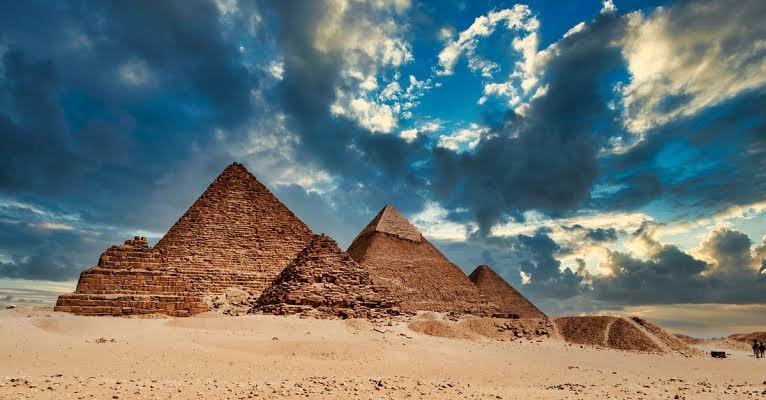
The Giza Plateau contains the pyramids of Khufu, Khafre, and Menkaure, together with the Great Sphinx and other structures.
These sites demonstrate how Egyptian pyramid architecture developed over time.
What Is Still a Mystery About the Pyramids?
Even after decades of archaeological research, important questions remain.
Researchers continue to study:
- The exact construction sequence
- The precise design of some ramps
- The purpose of certain internal spaces
- The logistics of transporting enormous stones
- Undiscovered archaeological evidence
- The full meaning of certain architectural features
A mystery does not automatically require a supernatural explanation.
In archaeology, an unanswered question simply means that researchers need more evidence.
This distinction is essential when examining Pyramid Myths vs Historical Facts.
Frequently Asked Questions
Did aliens build the pyramids?
No credible archaeological evidence supports the claim that extraterrestrials built the Egyptian pyramids. Evidence points to organized Ancient Egyptian workers and construction systems.
Were the pyramids built by slaves?
The evidence from Giza indicates a complex workforce of laborers, skilled craftsmen, administrators, and support workers. The idea that the entire workforce consisted of slaves is an oversimplification.
How were the pyramids built?
Ancient Egyptians used quarrying, boats, sledges, ropes, ramps, levers, stone tools, surveying techniques, and organized labor. The exact construction method varied between monuments and remains partly debated.
Did the Egyptians have advanced technology?
Ancient Egyptians possessed impressive engineering, mathematical, and architectural knowledge. However, there is no evidence that they possessed modern industrial technology.
Was the Great Pyramid originally white?
The Great Pyramid was originally covered with smooth limestone casing stones that gave its exterior a bright, polished appearance. Most of this casing has disappeared over time.
Were the pyramids tombs?
The pyramids were royal funerary monuments associated with Egyptian beliefs about kingship and the afterlife. The Great Pyramid was built for Pharaoh Khufu.
Is there still undiscovered information inside the pyramids?
Yes. Modern research continues to investigate the internal structure of the pyramids, and non-invasive technologies have identified previously unknown spaces and features.
Conclusion
Pyramid Myths vs Historical Facts reveals a fascinating distinction between popular stories and archaeological evidence.
The pyramids were not built by aliens, mysterious lost civilizations, or supernatural forces. Instead, the evidence points to Ancient Egyptian workers, architects, surveyors, craftsmen, administrators, and transport specialists who combined practical technologies with extraordinary organization.
the same time, the pyramids are not completely understood. Questions about construction techniques, internal spaces, logistics, and architectural decisions continue to inspire archaeological research.
That combination of evidence and mystery is what makes Egypt’s pyramids so fascinating.
The Great Pyramid of Giza remains one of humanity’s greatest architectural achievements. Its true story does not need an imaginary explanation. The knowledge, organization, and determination of the Ancient Egyptians are remarkable enough on their own.